I turn early-stage chaos into companies that grow.
I help companies find what's working, fix what isn't, and grow. My work sits across product, retention, go-to-market, and operations, and I approach it the way I approach art: intuitively, creatively, and with an eye for the whole picture. I founded Elements Haus. Outside of building, I paint, write poetry, and read philosophy, and I care about things made with intention, whether it's a company, a sentence, or a vintage.
Notes and Writings

The $5B admission: The model is no longer the product.
The data tells the story: MIT’s Project NANDA recently revealed that a staggering 95% of custom enterprise AI pilots return zero measurable P&L impact. The breakdown isn’t happening because the models lack intelligence. It’s happening because they hit a wall when meeting legacy data, rigid workflows, and organizational inertia.
Charlie Munger always advised studying historical bottlenecks to understand where value naturally clusters. We are watching a well-worn playbook repeat itself:

The man who built Midjourney made a machine that scans your body with sound. An essay on AI's return to atoms — chips, power, robots, and the body it asked for.

The convergence of AI and crypto is not about decentralized compute or AI tokens. The real opportunity lies in trust infrastructure: systems that combine cryptographic verification, content provenance, persistent identity, and economic accountability to make truth verifiable in a world of infinite synthetic media.
AI has made it trivially cheap to clone voices, generate faces, and fabricate video. Crypto — through primitives like public verification, immutable timestamps, and programmable trust — offers one of the only scalable paths to rebuilding authenticity online. This is why the largest venture funds in both industries are quietly converging on the same problem.

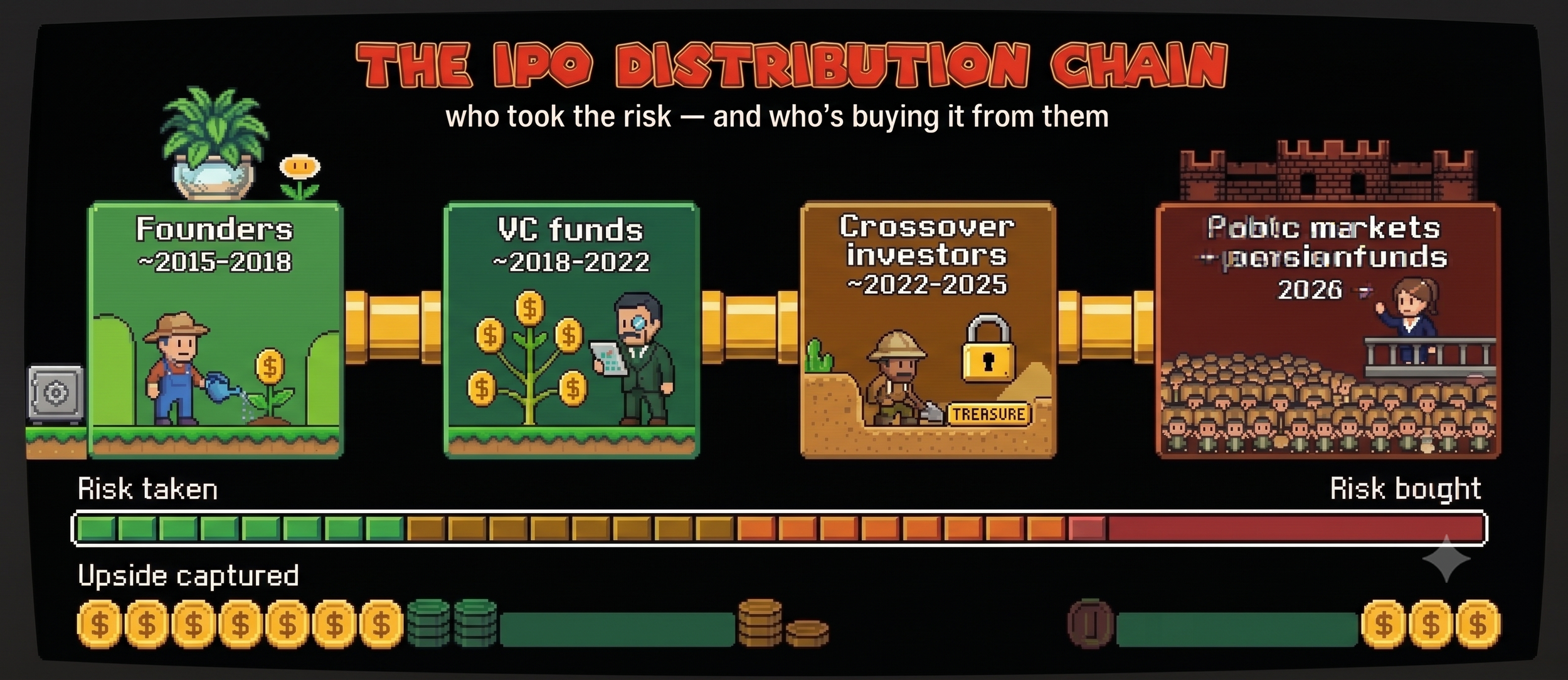
Venture capital isn’t purely rational. This essay explores how belief, psychology, and narrative shape investment decisions across markets like the US, Canada, and emerging ecosystems.


In an era of infinite noise, Stillness is the ultimate competitive advantage. This post explores the 'ROI of Stillness' through the lens of High Agency, Radical Accountability, and Decision Equity. Learn why increasing your 'Cognitive Voltage' is more valuable than increasing your velocity, and discover a curated reading list for the modern non-reactive builder.


We’re entering the Age of Personal Infrastructure—a transformative era where a single person can achieve what once required entire teams and organizations. Powered by AI copilots, no-code tools, and intelligent platforms, individuals now possess the ability to design, build, and scale systems entirely on their own.
This is not just a productivity boom—it’s a redistribution of power. Platforms like Replit, Vercel, Runway, Notion, and Gamma form the new digital stack of one, enabling creators, entrepreneurs, and operators to turn ideas into real-world impact faster than ever before.
In this AI age, humans no longer expand by adding people—they expand by integrating smarter tools. The most scalable unit of the economy is now the individual. This revolution redefines ownership, creation, and value at every level, ushering in an era where curiosity is capital and personal infrastructure is leverage.
For futurists, builders, and investors alike, understanding this shift is critical. The next wave of opportunity lies in tools that scale human potential, not replace it.