The synthetic internet needs a trust layer
A week or so ago, Chris Dixon posted about raising Fund V for a16z Crypto. Right on his heels, Haun announced they'd secured fresh capital for crypto investing too. Meanwhile, AI funding has been pulling in staggering numbers, and rightly so. Beyond LLMs, these are generational raises designed to help teams win at infrastructure scale.
Crypto funds raised billions to reinvent trust. AI companies raised tens of billions to reinvent intelligence. Different people. Different conferences. Different vocabulary. One side talking about blockchains, wallets, decentralization, programmable money. The other talking about models, compute, inference, synthetic media, and replacing human cognition. On the surface: unrelated.
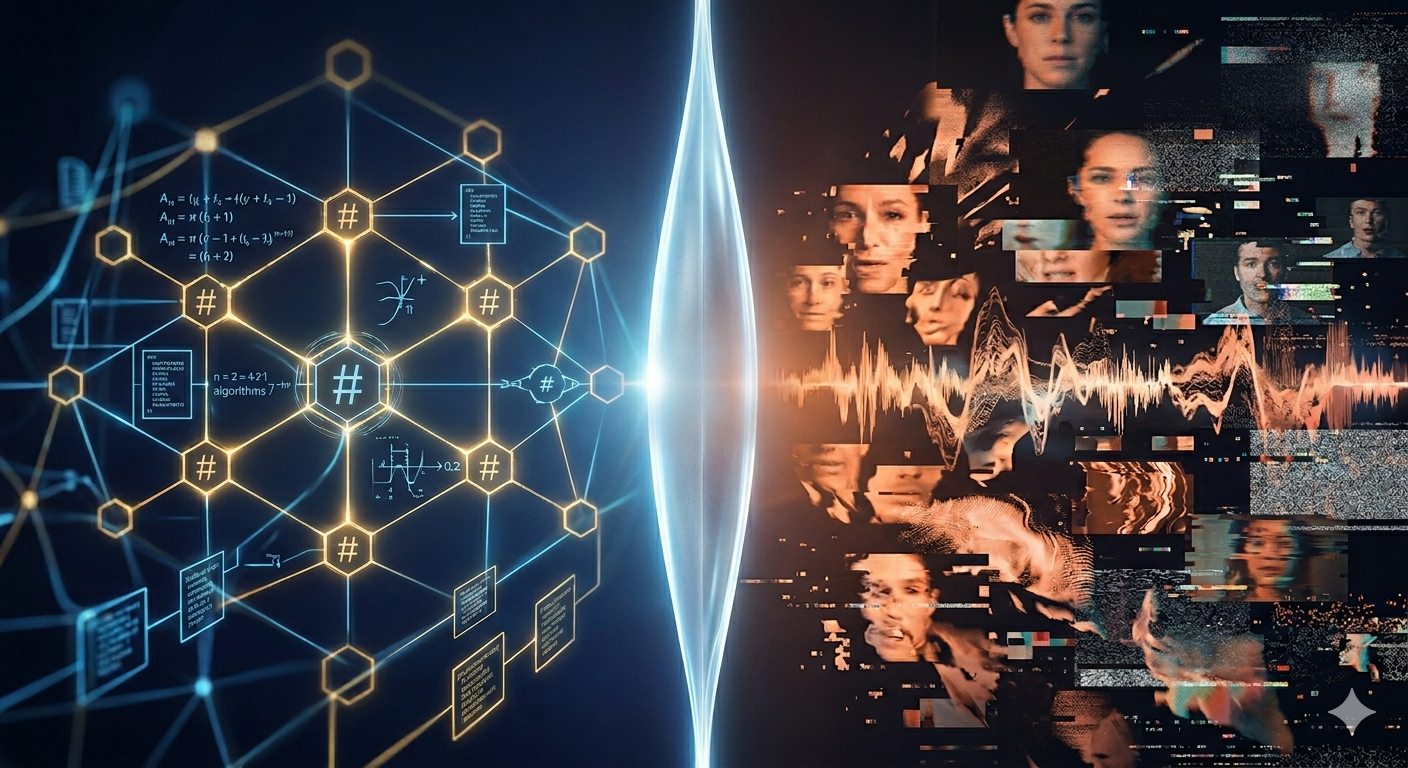
But the more both industries matured, the more obvious the collision became. Not because "AI and crypto are converging”, that sentence has already been beaten into meaninglessness. The real connection is darker and more interesting: AI is making reality cheaper to fake. Crypto is one of the few internet-native systems trying to make truth verifiable again. And that changes everything downstream.
Follow the money first
Narratives follow capital far more than people admit, and I've written about this before. Crypto didn't become culturally important because people suddenly cared about decentralization. It became important because some of the largest venture firms in the world made gigantic bets on rebuilding internet infrastructure around ownership and trust. a16z raised $2.2B in 2021, then $4.5B in 2022. Paradigm raised $2.5B. Haun launched with $1.5B. Even after Terra, FTX, and the broader 2022 meltdown, the dry powder didn't disappear. The industry got more cynical, less euphoric, but the capital remained.
Then generative AI escaped the research labs and hit mainstream consciousness. Microsoft poured over $10B into OpenAI. Amazon and Google committed billions to Anthropic. xAI raised billions almost instantly. Every major venture fund pivoted toward AI infrastructure, tooling, or applications. The scale became almost incomparable, crypto funding cycles looked massive until AI started vacuuming up capital at hyperscaler speed.
But what fascinated me wasn't the size difference. It was the philosophical inversion. Crypto spent years asking how we verify ownership, identity, and transactions online. AI arrived and accidentally detonated all three.
The detonation
The internet was never designed for synthetic reality. We built platforms on a silent assumption: that seeing meant believing, that hearing implied authenticity, that identity was expensive to fake. AI destroys all of those assumptions simultaneously. Anyone can now clone a voice, generate a face, fabricate a livestream, mass-produce persuasion — and the cost keeps approaching zero.
The dangerous thing about AI isn't intelligence. It's infinite media generation. That changes the economics of deception itself.
Once I started thinking about AI through the lens of incentives rather than technology, crypto suddenly became the obvious first battlefield. Of course deepfake scams exploded there first. Crypto already had speculative audiences, irreversible payments, pseudonymous actors, global liquidity, fragmented trust, and extreme information asymmetry. It was already vulnerable to social engineering before AI arrived. AI just industrialized it. Fake founder videos, fake token launches, voice-cloned urgent transfers, synthetic influencers running scams.
At one point, a fake Nvidia livestream using a Jensen Huang deepfake attracted massive attention while running a crypto grift. That incident felt symbolic, not because it was technically impressive, but because it revealed the actual problem. The question is no longer whether anyone can make a convincing fake video. That's solved. The question is: how does anyone know what's real at internet scale?
Where crypto becomes interesting again
Not because of tokens. Not because every AI product needs a blockchain, most "AI + crypto" projects are still terrible. (Coming in hot? Maybe. But it's true.) Slapping a token onto an AI wrapper is not innovation. Putting model inference onchain usually makes no economic sense. "Decentralized AI" is mostly just centralized AI with extra latency and worse UX.
But beneath the noise is one genuinely important idea: AI creates uncertainty. Crypto creates verifiability. That's the actual overlap.
Crypto's most valuable primitives were never memecoins. They were public verification, programmable trust, immutable timestamps, cryptographic signatures, persistent reputation. Those primitives matter exponentially more in a world where reality itself becomes fluid.
The nuance nobody wants to say out loud
Crypto does not solve deepfakes. And AI detection alone is a losing game, detection models will always lag generation models. The better approach is provenance: where content came from, who created it, who modified it, whether the chain of authenticity stayed intact. This is why standards like C2PA and Content Credentials matter. Not because metadata is exciting, but because the internet desperately needs memory.
The problem is that provenance only works if platforms preserve it. Most social platforms strip metadata, hide provenance signals, or fail to surface them meaningfully. They optimize for engagement, not authenticity. Which means even a perfect verification system becomes irrelevant if the distribution layer ignores it.
This is the uncomfortable truth the tech industry keeps avoiding: truth is not only a technical problem. It is a distribution problem.
What actually wins
The products that matter won't be pure deepfake detectors. They'll be trust infrastructure, systems that combine provenance, identity, reputation, cryptographic verification, behavioral history, and economic incentives. Not individually. Together.
The future winners look more like authenticity layers, trust middleware, verified media networks, and reputation systems for both humans and agents. Not AI coins.
The most underrated product category right now is deepfake-resistant advertising infrastructure, especially for finance, politics, crypto, and high-trust transactions. Ads are fundamentally broken. Platforms optimize for attention, not authenticity. In an AI-native world, unsigned media becomes dangerous. Imagine every financial ad cryptographically signed, every issuer tied to a verified identity, every livestream carrying provenance, impersonation triggering automatic warnings. That's not a blockchain pitch. That's what trust looks like when the old assumptions have collapsed.
Then agents arrive
It gets stranger once AI agents start operating economically. Because agents will transact, negotiate, publish, market, persuade, and trade, at scale, without sleep. That means agents need wallets, permissions, reputation, accountability, transaction history. Suddenly crypto infrastructure starts looking less speculative and more structural. Not as consumer finance, but as coordination rails for non-human actors. Which sounds futuristic until you realize parts of it are already running.
The irony
Crypto spent years building trustless systems because humans were unreliable. AI arrived and made human perception itself unreliable. Now both industries are colliding around the same question: in a world of infinite synthetic media, what becomes trustworthy?
The answer probably isn't complete decentralization. Or complete centralization. It's layered verification, cryptographic proof plus institutional trust plus persistent reputation plus provenance plus economic accountability. Messy systems. Hybrid systems. Human systems. Because reality itself is becoming probabilistic online.
The next internet economy won't be constrained by information scarcity. It will be constrained by authenticity scarcity. That changes what becomes valuable. In a world where content is infinite, truth is premium.
The biggest AI × crypto opportunity isn't decentralized compute, AI marketplaces, or inference tokens. It's rebuilding trust infrastructure for the synthetic internet.
That's the bet worth making.