The Body It Asked For
AI, hardware, and the long way back to atoms
In June, in a building in San Francisco, the man who taught machines to dream pictures unveiled a machine to look inside your body.
David Holz built Midjourney, the tool that turned a sentence into an image, that made a whole generation fluent in conjuring worlds out of nothing but words. His new thing has no prompt box. It is a ring of thousands of ultrasound sensors. You step onto a platform, it lowers you into a shallow pool of water, sound passes through you from every angle and resolves into a three-dimensional portrait of your own muscle and fat and bone. He calls it the Midjourney Scanner. He says it sees what an MRI sees without the radiation or the magnets, and he wants to build a fleet of fifty thousand of them, the first ten installed in a wellness spa off Union Square.
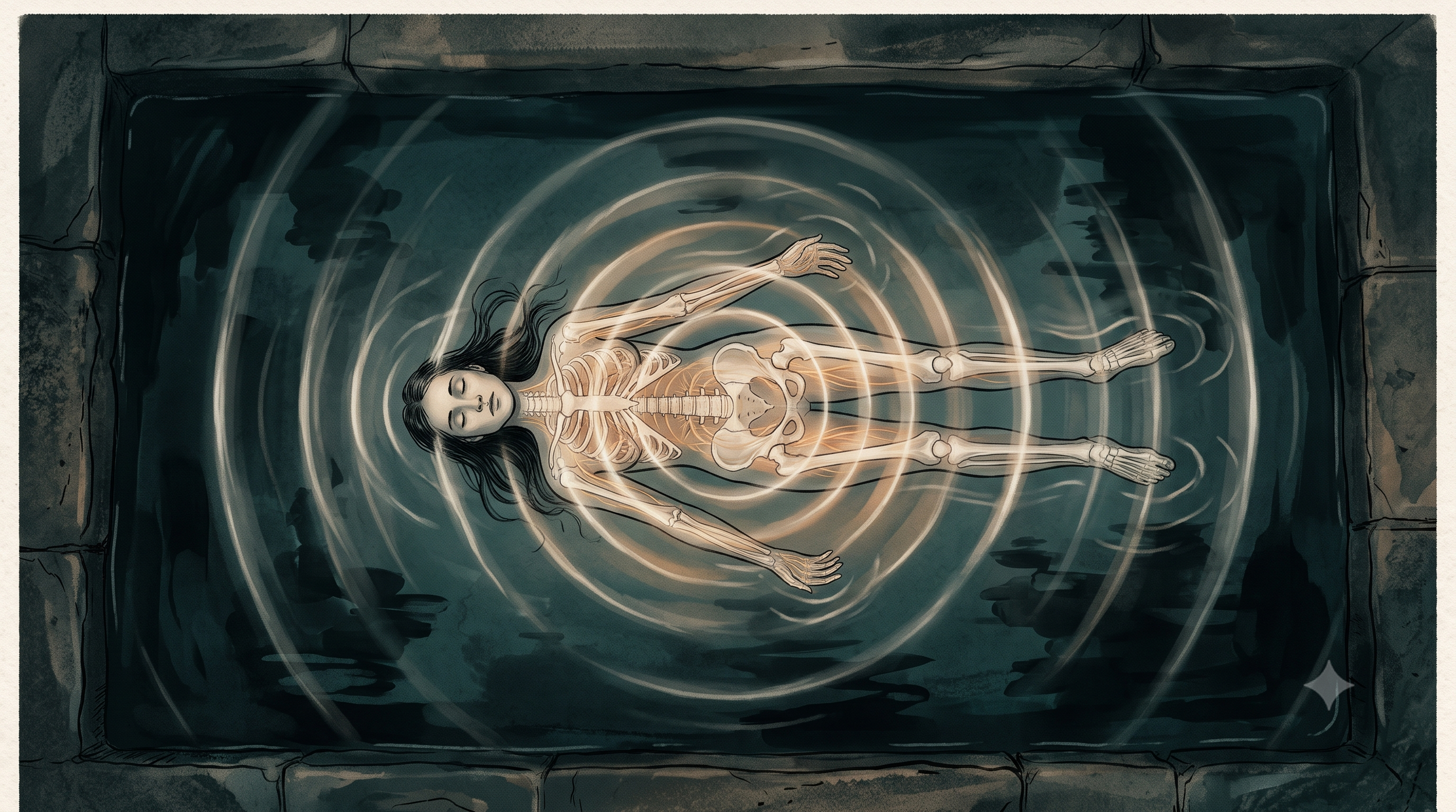
It is tempting to read this as a swerve. Image company stumbles into healthcare. It is the opposite of a swerve. Before Midjourney, Holz built Leap Motion, a device that tracked the human hand moving through the air. Before that he was at NASA and at the Max Planck Institute, working on the physics of the actual world. His career runs in one direction and then reverses it. Atoms first... hands, spacecraft, sensors. Then bits, a pure engine of imagination that touches nothing. And now atoms again, reaching all the way back into the wet interior of the body. One man, oscillating. He is not the exception. He is the whole story in miniature.
For about seventy years, computing has been a flight away from matter. Almost everything we called progress was, underneath, an act of subtraction... removing weight, removing heat, removing the visible machine until the machine seemed to disappear. And now, at the exact moment we have built the most abstract thing we have ever made, intelligence with no body, pattern without flesh, a mind assembled entirely out of language, that thing has turned around and reached back for the world of atoms with both hands. The chips. The power. The hand. The room. The skin.
The interesting question was never whether the machine can think. It does something close enough that the distinction has stopped paying its rent. The interesting question is the one underneath: where will it live, what will it touch, what will it cost... and what happens to the part of us that is also, stubbornly, made of atoms.
The vanishing
Start with the word. We say hardware as if it means gadgets... the phone, the pin, the watch on the wrist. But hardware is only the part of the machine that has a body. It has weight. It draws power. It gets hot. It wears out. It sits in one place and cannot be in two places at once. Software is the part that forgot all that... that copies itself a billion times for nothing, that has no address, that never ages. The entire history of the computer is the history of pushing as much of the world as possible across that line: from the side that costs to the side that is free.
The line itself was named at the Media Lab in 1995, when Nicholas Negroponte published Being Digital and drew the cleanest distinction in modern technology: atoms versus bits. Atoms are things you ship in trucks; bits are things you send down a wire. He told us, correctly, that the future belonged to bits, and that we would spend a generation converting one into the other: books into files, records into streams, film into pixels, money into numbers in a database. He was right about all of it. What is strange to sit with now is that the same building, the same intellectual lineage, has spent the last two years obsessed with nothing but atoms... with the gallium and the copper and the cooling water that the bits turned out to require.
The flight began earlier, in 1947, in another building, when three physicists at Bell Labs made a small piece of germanium amplify a current and called it a transistor. It was the first time anyone had reliably made thinking out of matter... a switch with no moving parts, a decision rendered in a crystal. From there the trajectory is almost a moral parable about hiding. The integrated circuit folded thousands of those switches onto a single sliver. The microprocessor folded the whole computer onto one chip. The personal computer put it under a desk; the laptop closed it into a clamshell; the phone slid it into a pocket. And then came the masterstroke of forgetting. We took the largest, hottest, most physical machines we had ever built, buildings full of them, drawing the power of small cities, and we named them the cloud. A word chosen, whether anyone admitted it or not, so that you would stop picturing the warehouse.
By 2011, when Marc Andreessen wrote that software was eating the world, the victory of bits over atoms felt total and permanent. Why own a thing when you could rent its function. Why manufacture when you could orchestrate. The most valuable companies on earth made nothing you could drop on your foot. This was the air we all breathed, and it was true, and it is the thing that is now quietly reversing... not because anyone repented of it, but because intelligence, once it became real, turned out to be the most physical thing of all.
The amulet

Watch where the reach for atoms went first, because it tells you something the spreadsheets won't. It went for the body.
In early 2024 two companies promised to free us from the screen. Humane made a pin you wore on your chest, with a laser that projected onto your palm and an assistant that was supposed to live with you and answer to your voice. Rabbit made a small bright square with a scroll wheel and a push-to-talk button. Both were beautiful pieces of intention. Both failed with a completeness that should be studied for years. Humane raised something like two hundred and thirty million dollars, shipped fewer than ten thousand pins, and sold the corpse to HP, which switched off the servers and turned every device still in the world into a small warm brick. Rabbit sold a hundred thousand units and then watched daily use collapse to a few thousand. By one industry count, the great majority of AI hardware startups in that wave simply died.
The autopsy everyone wrote was about features and latency and price, and all of that is true and all of it misses the human layer. The pin and the square failed because they asked a person to carry a new object, and a new object has to justify its existence against the extraordinary thing already in your pocket... a bright fast screen with every app and the entire internet and your whole social world, which you have already paid for and already trust. The moment the AI got good enough to matter, it appeared on that screen too, for free, and the dedicated device was left holding the one thing nobody wanted: another thing to charge, another thing to lose, another seam between you and the world.
And yet look at the form the survivors take. Meta's camera glasses, the product almost nobody predicted, now hold the overwhelming share of the AI-glasses market and ship in the millions, with the Qualcomm chief predicting the category reaches a hundred million units within a year or two. OpenAI, after buying Jony Ive's hardware startup for north of six billion dollars, is building something screenless and voice-first that Sam Altman calls peaceful and that the design language calls calm computing... reportedly a small thing for the neck or the ear, codenamed like a garden (Sweetpea, Gumdrop), meant for the second half of this year, built around a custom chip and a war on the screen. Foxconn is tooling for tens of millions of units before anyone has held one.
Notice the pattern. The devices that fail are the ones that sit in front of you, demanding to be operated. The ones people will tolerate sit on you... on the face, in the ear, around the throat. We are, it turns out, willing to wear the machine but not to face it. This is older than technology. The amulet, the relic, the talisman, the saint's medal worn under the shirt... every culture has the object held close to the skin to carry a power the wearer cannot generate alone. Jung would have called the pendant around the neck what it plainly is: a fetish in the precise sense, an external thing invested with an interior need. The companies racing to put AI on the body are, whether they know it or not, competing to become the next amulet. That is a far stranger and more intimate ambition than "phone replacement," and it deserves more suspicion than it gets.
Here is the suspicion. There is a comforting story being told right now that the answer is ambient intelligence... AI that disappears into the things you already have and own, that never asks to be a separate object, that is simply present. It is a seductive story because it is the opposite of the failures. But "invisible and everywhere" is not obviously a solution to the human problem; it may be the deeper version of it. A pin you can take off. A presence woven into your glasses, your ear, your room, your car, the wall... that you cannot. The thing about an amulet is that you choose to wear it. The thing about ambient intelligence is that, done well, you forget it is there at all.
The cloud was the heaviest thing we ever built
The gadgets are the part of this story you can see. They are not the part that matters most. The real reach for atoms is happening at a scale that has no precedent in the history of private capital, and almost none of it fits in your hand.
To make an intelligence, you need a particular kind of matter, refined to a degree that is hard to picture. The advanced chips that train and run these models are arguably the most precise objects our species manufactures... patterns etched at the scale of a few atoms, on machines (the extreme-ultraviolet lithography systems built by a single Dutch company, ASML) that cost more than aircraft and exist nowhere else. The chips themselves come almost entirely from one company's designs (Nvidia) fabricated almost entirely on one island (Taiwan, at TSMC), and the true bottleneck in 2026 is not even the chip but the packaging... the advanced stacking that marries the processor to its memory, a capacity that has been sold out more than a year in advance. The four largest cloud companies have committed somewhere north of six hundred and fifty billion dollars to this buildout in a single year, and they have not revised it down.
This is the part the bits-versus-atoms story gets backwards. We told ourselves intelligence would be the lightest thing we ever made. It is the heaviest. And the place that truth becomes undeniable is power.
For two years the constraint everyone watched was chips. It has quietly become electricity. A single large AI data center can draw the power of a small city, and the modern racks are so dense they can no longer be cooled by air at all; they must be plumbed with liquid. The grid did not plan for this. In the largest data-center market on earth, the wait to connect new capacity now runs to three to five years... not because there is no power, but because there are not enough transformers, not enough switchgear, not enough high-voltage line and the heavy, slow, deeply physical apparatus that turns an announced megawatt into an energized one. By one analysis only about a third of this year's planned capacity is actually under construction. The capital is fully committed; the atoms to absorb it are arriving on a clock measured in years. The International Energy Agency expects data-center electricity demand to roughly double by the end of this decade, to something near the entire annual consumption of Japan, with AI as the driver. Nvidia's Jensen Huang has said, in his characteristic register, that AI will eventually need a thousand times today's energy. The hyperscalers are not buying software anymore. They are signing offtake agreements for nuclear reactors.
Sit with the reversal. We set out to build a god of pure mind, and we discovered it eats coal and gas and rivers. The cloud, the very word we chose to make ourselves forget about atoms, turned out to be the most physically consequential thing we have ever constructed, a planetary-scale machine whose binding constraint is not intelligence or capital or talent but the second-by-second availability of electric current. The Stoics, who were materialists to the bone, would not have been surprised. They held that the logos, the rational principle that orders the world, was not separate from matter but a kind of fire diffused through it... pneuma, breath-and-substance at once. There is no mind, on that view, that is not also a body burning fuel. We are relearning this at the scale of continents, and we are calling it an infrastructure problem.
And it might be a bubble. Six hundred and fifty billion dollars of committed capital that cannot be plugged in is not obviously a triumph; it can also be the precise shape of an overbuild. The honest version of this section is that nobody knows yet whether the atoms will revolt... whether the grid, the gas permits, the transformers, the water, and the politics of communities that do not want a server farm next door will let this buildout happen on anything like the schedule the spreadsheets assume. The romance of "the return to atoms" should not be allowed to hide the fact that atoms are slow, and that slowness has bankrupted faster stories than this one.
The hand
Then there is the oldest dream, the one that predates the computer and may outlast it: the machine that moves through the world the way we do. Not a mind in a box but a mind with a hand.
For most of a century this stayed in the realm of demonstration... the viral video, the lab machine that could do one rehearsed thing for the camera and nothing else. What changed, and changed fast between 2025 and now, is that the same kind of model that learned language learned action. These are called vision-language-action models, and the shift they represent is almost philosophical. The old way to make a robot keep its balance was to write the physics down... tens of thousands of lines of hand-tuned code specifying what to do in every case an engineer could foresee. The new way is to let the machine learn it the way a child does, from demonstration and consequence. One company, Figure, reported replacing roughly a hundred and nine thousand lines of balance code with a single learned network a fraction of the size. That is not a faster horse. That is the moment the engineering became learning.
The deployments are real now, in a way they were not eighteen months ago. Figure's robots work a real line at a BMW plant in South Carolina, and the company says its second customer took thirty days to onboard against the first one's twelve months... the curve you want to see, the curve where each new task gets cheaper. Boston Dynamics is shipping an electric Atlas. Agility's robots move totes in warehouses. By one count there are something like fifty thousand humanoids working commercially this year, up from sixteen thousand at the end of last. Somewhere near forty billion dollars of venture money has poured into the field.
I want to be careful here, because this is the area where the gap between the demo and the deliverable is widest and most lucrative to obscure. A great many of the most stirring robot videos, including some of the most famous, have turned out on inspection to involve a human operator off-camera, working the machine by remote. One head-to-head this spring scored Tesla's Optimus far behind Figure on actual real-world traction, precisely because Figure has a paying customer publishing its own numbers and Tesla, for all its ambition and its converted factory and its million-units-a-year target, has admitted on its own earnings call that the robots in its plants are there to gather training data, not yet to do useful work. "Best positioned to win later" and "ahead today" are different sentences, and the people selling you the future are paid to blur them. The hand is the hardest problem in this entire essay. Language is forgiving... a clumsy sentence costs nothing. A clumsy grip drops the glass, or worse.
And the hand is where the geopolitics of atoms turns brutal, which a strategist cannot look away from. The brain of these robots, the model, is largely Western. The body is largely Chinese. China holds something near ninety percent of the world's permanent-magnet processing and dominates the motors, the bearings, the actuators, the precise mechanical parts a humanoid is mostly made of, because those parts sit right next to the electric-vehicle supply chains it already built. One analysis found that sourcing a leading robot's bill of materials without Chinese suppliers would nearly triple its cost... from around forty-six thousand dollars to a hundred and thirty-one. This is the question that should keep anyone honest about value: in a world where the mind is American and the body is Chinese, who actually captures the margin... and what does it mean that the part we are best at is the part that weighs nothing?
Where the value goes to live
Step back and the business question resolves into a single old law: value accrues to whatever is scarce, and scarcity moves.
For thirty years the scarce thing was software: the code, the network effect, the platform. And so the value lived in bits, and the people who owned the bits became the richest institutions in history while the people who made the atoms (the contract manufacturers, the component suppliers, the assemblers) fought over crumbs. Hardware was, in the industry's own weary phrase, hard: thin margins, brutal logistics, unforgiving physics, the constant threat of commoditization. The smart money stayed in bits on purpose.
What is happening now is that intelligence itself is becoming abundant, a capability you can summon by the token, cheaper every quarter. And the moment a thing becomes abundant, the value drains out of it and pools around whatever it now depends on and cannot get. So what does abundant intelligence depend on? The scarce chip. The advanced packaging that is sold out. The electricity that takes five years to connect. The robot body whose magnets come from one country. The trust required to let a machine act in the physical world on your behalf. Every one of those is an atom problem. The value is migrating back into matter not despite the triumph of bits but because of it. We made mind cheap, and in doing so we made everything mind touches expensive.
This reframes the strategy entirely. The graveyard taught the first lesson: do not sell a person a new object; sell them a removed friction, and let it ride inside an object they already trust. The infrastructure crunch teaches the second: in this cycle, owning the bottleneck beats owning the brand, and the bottlenecks are physical... fab capacity, packaging, power, rare materials, the geography of where atoms can actually be made. The robot economics teach the third: the winning model is increasingly not selling the atoms at all but renting their function... robot-as-a-service, capability by the hour, the same dematerialization Andreessen described, now applied to the hand. And the whole arc teaches a fourth lesson, the one most relevant to anyone thinking about where capital should sit for the next decade: the question is no longer "software or hardware." It is which atoms, made where, owned by whom... because the map of who controls the physical substrate of intelligence is being redrawn right now, and most of it is being drawn outside the West.
The dualism
I have been writing this essay as though it has a clean shape... a flight from atoms into bits, and now a return. It is a useful shape. I no longer fully believe it, and I want to say why, because the most interesting thing in this whole subject is not a product or a number. It is that the entire framing is built on a mistake that is four hundred years old.
The bits-versus-atoms line, the mind-versus-body line, the spirit-versus-matter line... they are all the same line, and we inherited it from Descartes, who cut the human being into a thinking thing and an extended thing and could never satisfactorily glue them back together. Everything in this essay is downstream of that cut. We built a technology of pure thought because we believed thought could be pure, could be separated from the meat and the heat and the place, and we are surprised, plainly surprised, to find it dragging a body behind it. We should not be surprised. The traditions I trust were telling us the whole time that the cut was never real.
The Sufis did not treat matter as the prison of spirit; they treated the visible world as tajalli, the self-disclosure of the real... the breath of the Compassionate condensing into form, so that to touch the world is already to touch what made it. The alchemists Jung spent his last decades reading were not trying to escape the body into spirit; they were after the coniunctio, the wedding of the two, the gold that is spirit-become-matter and matter-become-luminous, and they insisted the work could only be done in the materia, in the actual vessel, with the actual substance, hands dirty. And the Zen answer to the question of where enlightenment lives has always been the same flat refusal of the dualism: chop wood, carry water. There is no awakening that floats above the act. The body is not the obstacle to the practice. The body is the practice.
Read against that, the "return to atoms" is not a story about AI growing a body. It is a story about us being forced, by a technology we built to be bodiless, to remember that we never left ours... that intelligence without a place to stand and a current to burn and a hand to fail with was always a fantasy, and a specifically modern, specifically Western one. The machine is not becoming embodied. It is reminding us, expensively, that embodiment was never optional.
Which is where the real risk lives, and it is not the risk the headlines name. The danger was never that the machine gets a body. The danger is that we hand ours over. I wrote once that we are building a world that will have poems but not poets... that the artifact will survive while the human process that made meaning out of making it quietly dies. The hardware version of that sentence is sharper. We are building presence-machines at the precise historical moment we are lonelier than we have ever been; we are building hands at the moment we touch each other less; we are building the amulet that listens, the glasses that see for us, the robot that does the physical work that used to be how a person stayed in their own life. The seduction is not that any of this fails. It is that it succeeds... that it works so well we let it carry the part of being human that was never supposed to be outsourced, the part that lives in the body precisely because it cannot be copied for free. We may end up with hands everywhere and touch nowhere. With presence on every surface and persons increasingly absent from the room.
That is the question to take back to the spa off Union Square, and to the ring of sensors lowering a body into water to be seen from the inside.
We are going to keep building these machines... the ones that look into the body, the ones that stand in the room, the ones that hold the hand and grip the part and wear close to the skin. We will build them because the bits, in the end, kept pointing back at the body; because intelligence turned out to be the heaviest thing we ever made; because the atoms were always the point and we spent seventy years pretending otherwise.
The machine will get the body it asked for. The only question that was ever ours to answer is what we still intend to do with the one we already have.